The new year often makes me think about what I haven't done - much more so than what I've accomplished in the last 12 months. That said, I'm much more forward thinking this January than in the past. Perhaps it's because I've had time to actually think and do since leaving my job in June. And, while I've been an erratic blogger (at best), I'd like to try and be a bit more focused and deliberate here, with an eye toward documenting my fiber and textile work. Hopefully, this will help me organize what I'm doing a bit more and, with it being public, help keep me motivated and on track.
A group of friends started talking about fiber goals for the year and I managed to come up with a few dead simple ones. I think they're good, in line with what I *need* to do, and while not easily achievable, certainly possible.
1. Decrease the stash. Nothing comes in until what I have is sorted and deemed "stay" or "go". I've not renewed any of my clubs (how I will miss the sock patterns!) and I'm absolutely dedicated to getting a handle on what I have. There's plenty there to keep me busy and to push me to be creative. No problem!
2. Weave fabric for, and sew a garment. Not handspun in any way; rather, this is an exploratory effort to understand garment fabric and construction. A simple kimono-style jacket, in cotton, is exactly what I both want and need. Again, there's plenty in stash to do this, and even embellish a bit if I so chose.
3. Define and embark on a fiber/color study plan. I've spent a good chunk of time trying to understand just what it is about this craft that fascinates me so. And, unsurprisingly, I had a flash of insight whilst on a run. That inspiration gave me the thought of starting an exercise in fiber/color interplay focusing on the interaction between content and medium. Blending of fiber types and studying how they accept color and then behave in pieces is what I'm after. The next step is to work on a study plan to define specific experiments and projects. Fortunately, I'll have some time with a friend/mentor at the end of the month and I'm hoping she'll be willing to give some guidance.
So, that's it. It's rather a lot, really, but I'm excited about all of it. In between, there's getting ready for Art Fair in the fall (it's only 28 weeks away) and getting back into a routine of running and exercise. It's time to embrace fully this new life I've chosen. I played at it for a while, but it can be, and is, wholly satisfying. It's a year of good fortune and thanks. Let's begin!
And I'll do the books next week. :-)

The Art of the Start
I love starting things. I love that thrill of anticipation when the project is new, the end vision is clear, a plan is formed and nothing has yet gone wrong.
Solving and avoiding problems is a big part of what I do in the real world and just getting through a week at work can really deplete my reserves when it comes to being able to motivate myself and also deal with whatever mistakes and problems life at home throws my way. But, once I find the energy to address them, I nearly always end up learning something in the process.
Witness my handwovenmistakes towels. Here's what they look like:

They look great, don't they? In the process of finishing them, I had to resley portions of the reed (490 ends!), twice fix serious pattern threading errors, fix two crossed threads, fix tension issues and even deal with one snapped warp thread. The first problem was after 4 hours of work - and one that cost me nearly two weeks worth of progress simply because I wasn't in a position to find another 4h uninterrupted block of time. It felt like a brick wall that was miles high and topped with barbed wire. I did eventually cobble together an afternoon to address the problem (being sick has its advantages) and once I cleared that hurdle, all those other issues weren't quite so horrible. Each could be fixed rather quickly but their collective power came from being "one more thing" that I had done wrong. So many mistakes. So much "wasted time". But was it?
Knitting has, over the years, given me a gift - it's ok to start over. I can't always start over with weaving, but a smart teacher of mine told me to "finish things, even if they're wrong. You'll be surprised at the result." What's buried in there is the gentle reminder that mistakes are learning experiences. And you know what? She's right. In hindsight, I'm glad that I made those mistakes on my towels. I tried. I experienced. I learned. And on the next set of towels I make, I'll make different mistakes, or even some of the same ones, but hopefully they won't be so emotionally burdensome.
I love those towels. What a beautiful mistake.
Solving and avoiding problems is a big part of what I do in the real world and just getting through a week at work can really deplete my reserves when it comes to being able to motivate myself and also deal with whatever mistakes and problems life at home throws my way. But, once I find the energy to address them, I nearly always end up learning something in the process.
Witness my handwoven
They look great, don't they? In the process of finishing them, I had to resley portions of the reed (490 ends!), twice fix serious pattern threading errors, fix two crossed threads, fix tension issues and even deal with one snapped warp thread. The first problem was after 4 hours of work - and one that cost me nearly two weeks worth of progress simply because I wasn't in a position to find another 4h uninterrupted block of time. It felt like a brick wall that was miles high and topped with barbed wire. I did eventually cobble together an afternoon to address the problem (being sick has its advantages) and once I cleared that hurdle, all those other issues weren't quite so horrible. Each could be fixed rather quickly but their collective power came from being "one more thing" that I had done wrong. So many mistakes. So much "wasted time". But was it?
Knitting has, over the years, given me a gift - it's ok to start over. I can't always start over with weaving, but a smart teacher of mine told me to "finish things, even if they're wrong. You'll be surprised at the result." What's buried in there is the gentle reminder that mistakes are learning experiences. And you know what? She's right. In hindsight, I'm glad that I made those mistakes on my towels. I tried. I experienced. I learned. And on the next set of towels I make, I'll make different mistakes, or even some of the same ones, but hopefully they won't be so emotionally burdensome.
I love those towels. What a beautiful mistake.
Training
As I mentioned in my previous post, I'm training for a marathon. That's not atypical for me as I enjoy running, even more so when I've got a goal to help pull me along. But, as I started thinking about this post, I realized that I'm training for so many other things as well.
Since I rediscovered handwork, most recently in the form of weaving, it's meant a lot to me to really be able to immerse myself in the learning process. That's allowed me to start training, and re-training, my brain to think beyond just analytics and the empirical - it's moved on to the creative and artistic side as well.
My life has really been formed by the scientific method and it's application to solving problems of all shapes and sizes. That's meant a heavy reliance on data, extrapolation, deduction and general reasoning. Spinning, weaving, knitting and these other wonderful fiber crafts are so much more (to me) about intuition and sense. There's most assuredly good science in there too - and the application of rigorous methods can really help in understanding a process or getting a specific result - but I find that I'm able to get results that satisfy me without applying so much rigor.
I also know that I won't grow/learn/become proficient if I don't start applying a bit more rigor in key places.
So, what does this boil down to? Training.
Oh and yes, I'm still running. Thank goodness this is a light week. I'm sick as a dog.
Since I rediscovered handwork, most recently in the form of weaving, it's meant a lot to me to really be able to immerse myself in the learning process. That's allowed me to start training, and re-training, my brain to think beyond just analytics and the empirical - it's moved on to the creative and artistic side as well.
My life has really been formed by the scientific method and it's application to solving problems of all shapes and sizes. That's meant a heavy reliance on data, extrapolation, deduction and general reasoning. Spinning, weaving, knitting and these other wonderful fiber crafts are so much more (to me) about intuition and sense. There's most assuredly good science in there too - and the application of rigorous methods can really help in understanding a process or getting a specific result - but I find that I'm able to get results that satisfy me without applying so much rigor.
I also know that I won't grow/learn/become proficient if I don't start applying a bit more rigor in key places.
So, what does this boil down to? Training.
Oh and yes, I'm still running. Thank goodness this is a light week. I'm sick as a dog.
73 Runs Before I Sleep
It's December 30th and I really don't know where this year has gone. There's been good, bad and ugly (as usual) but my biggest area of bad and ugly was exercise. Or, the lack of it.
I let myself go this year. Quite a bit, actually. Sure, I'd had some injuries and the weather was bad, but it's like I fell out of love with running. There were times when it was fantastic, but those really were the exception rather than the rule.
Times like these require dire measures. Yup, it's time to call on The Marathon.
I've therefore selected the Avenue of the Giants marathon, run in 2011 on May 1st. Hal Higdon has once again provided the training regimen (I'll be using Intermediate I, for those playing along at home) and I'm inserting myself at Week 2. Given that I'm not a hopeless lout, that should be fine.
Oh, and just to make it stick, I'm firing up the 100 Pushups regimen again. The strength training is important, so I'm gonna do it.
Did I run yesterday? Yes. 5.5 miles.
Did I run today? Yes. 5 miles (or so. Calf complained).
Will I run tomorrow, Saturday and Sunday? Yes. 5, 7, and 9, respectively. By Monday morning, there'll only be 70 runs to go. Doesn't seem like all that many, does it?
I let myself go this year. Quite a bit, actually. Sure, I'd had some injuries and the weather was bad, but it's like I fell out of love with running. There were times when it was fantastic, but those really were the exception rather than the rule.
Times like these require dire measures. Yup, it's time to call on The Marathon.
I've therefore selected the Avenue of the Giants marathon, run in 2011 on May 1st. Hal Higdon has once again provided the training regimen (I'll be using Intermediate I, for those playing along at home) and I'm inserting myself at Week 2. Given that I'm not a hopeless lout, that should be fine.
Oh, and just to make it stick, I'm firing up the 100 Pushups regimen again. The strength training is important, so I'm gonna do it.
Did I run yesterday? Yes. 5.5 miles.
Did I run today? Yes. 5 miles (or so. Calf complained).
Will I run tomorrow, Saturday and Sunday? Yes. 5, 7, and 9, respectively. By Monday morning, there'll only be 70 runs to go. Doesn't seem like all that many, does it?
A finished tote
Perhaps you'll remember a while back (Ok, a really long while back) my last post was about weaving for the Pick Up Tote from Woven Treasures. Well, I'd finished the weaving all the way back on Labor Day weekend and I've finally gotten the gumption to finish the bag.
My skills as a seamstress are laughable at best but I know enough to do pretty well. Anyway, here's the result:

Yup, it's a tote. The straps were sewn on relatively straight and the fabric wasn't stretched out of shape too much. As you can see, I added a gusset at the bottom to give it some structure.

Finally, when it came to finishing, I wasn't happy with the idea of just folding over the edges twice and top stitching. So, I used a length of bias tape to encase the open edges of both the woven fabric and the liner.

Now, having done this first one, I have a much better understanding of what I need to do differently next time so that my finished seams are better, the bag is more square, the handles are better and that it'll generally look more professional. Admittedly, I was in a bit of a rush this morning so I wasn't as careful about any of the details as I could have been. Honestly, I'm ok with that since this really was meant to be an experiment.
Whilst cleaning up, I nearly put away the belt shuttle for my inkle loom. As I had it in my hand, I chuckled a bit and thought, "No, this is going to be getting used, possibly even tonight. It can stay on the table."
I love this tote. Love.It. Don't worry Sara, the next one will be better. :-)
My skills as a seamstress are laughable at best but I know enough to do pretty well. Anyway, here's the result:
Yup, it's a tote. The straps were sewn on relatively straight and the fabric wasn't stretched out of shape too much. As you can see, I added a gusset at the bottom to give it some structure.
Finally, when it came to finishing, I wasn't happy with the idea of just folding over the edges twice and top stitching. So, I used a length of bias tape to encase the open edges of both the woven fabric and the liner.
Now, having done this first one, I have a much better understanding of what I need to do differently next time so that my finished seams are better, the bag is more square, the handles are better and that it'll generally look more professional. Admittedly, I was in a bit of a rush this morning so I wasn't as careful about any of the details as I could have been. Honestly, I'm ok with that since this really was meant to be an experiment.
Whilst cleaning up, I nearly put away the belt shuttle for my inkle loom. As I had it in my hand, I chuckled a bit and thought, "No, this is going to be getting used, possibly even tonight. It can stay on the table."
I love this tote. Love.It. Don't worry Sara, the next one will be better. :-)
A little weaving
I picked up a copy of Sara Lamb's Woven Treasures and I used it to do a woven band on my inkle loom a few months ago. However, I'd not done any of the projects yet and, when I started thinking about a new tote, this seemed like as good a time as any.

I've had some struggles with this project and I've learned a lot - which is why we do this, right?
First, a few details about the project.
Warp: Tahki Cotton Classic
Sett: 20epi using two 10epi heddles
Weft: Aunt Lydia's #10 Crochet Cotton
Draft: plain weave, warp faced
Loom: Schacht Flip, 20"
Inspiration: Pick Up Tote from Woven Treasures
1. Cotton Classic is a \*slippery\* yarn. It also is Big.
I struggled in getting tension constant when tying on the front apron. In hindsight, I should have tied in smaller groups (forget the 1" suggestion, 1/2" would have been better). I reknotted umpteen times, even after weaving a (short) header and inserting the sticks. I also should have pushed the knotted sections closer together. It's a little uneven at the start.
2. Tension is critical. CRITICAL!
Because I don't have a stand for my loom, I have to be creative in clamping it to work surfaces. With the softly beaten projects I've worked in the past, the clamping force required has been much less. On this project, I was constantly overpowering the lame little clamps that came with the loom and it was very difficult to muscle the heddles around to help clear sheds. I finally gave in and found the woodworking clamps out in the workshop and used them to properly secure the loom. I'm now moving heddles with confidence and am moving much more quickly. I'm also paying much more attention to the tension on the warp yarns to really make sure the ends will move past each other. Giving the beams that extra turn makes a huge difference.
3. 20epi is, indeed, as difficult as Sara points out.
For the first inch or so, I was working quite hard to get the ends to move past each other. they really are quite crammed into the slots given that there are three ends per and it's hard to get them to behave. My pick-up stick has been a godsend here and I'm using it to clear each and every shed before passing the weft. It's saved my bacon at least once in about every 4th or 5th shed.
4. 22 epi would be a better sett, indeed.
The fabric is still just a bit open, though once off the loom and washed, it may tighten up a bit more. I can see bits of daylight between the ends but I really can't see trying to warp this at 24epi on the Flip.
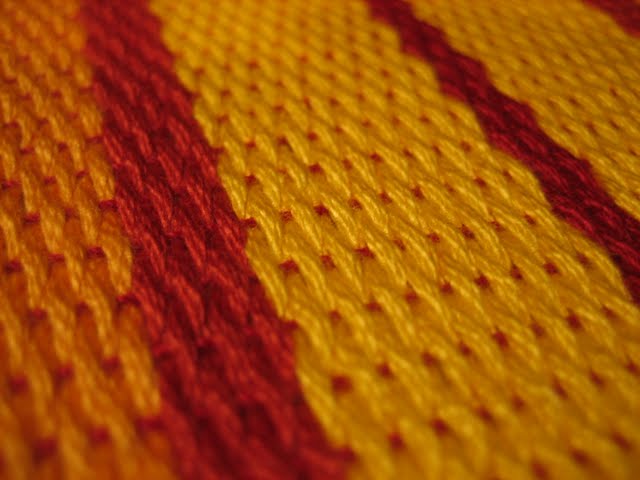
Overall, now that I've mostly sorted my process issues, I'm really enjoying this project. It's going very fast since the ppi number is low and I'm quite happy with the way the colors look. They're vibrant and cheery and I think this will make a great tote once completed.
Next step finish weaving the fabric and then warp the inkle for the band.
I've had some struggles with this project and I've learned a lot - which is why we do this, right?
First, a few details about the project.
Warp: Tahki Cotton Classic
Sett: 20epi using two 10epi heddles
Weft: Aunt Lydia's #10 Crochet Cotton
Draft: plain weave, warp faced
Loom: Schacht Flip, 20"
Inspiration: Pick Up Tote from Woven Treasures
1. Cotton Classic is a \*slippery\* yarn. It also is Big.
I struggled in getting tension constant when tying on the front apron. In hindsight, I should have tied in smaller groups (forget the 1" suggestion, 1/2" would have been better). I reknotted umpteen times, even after weaving a (short) header and inserting the sticks. I also should have pushed the knotted sections closer together. It's a little uneven at the start.
2. Tension is critical. CRITICAL!
Because I don't have a stand for my loom, I have to be creative in clamping it to work surfaces. With the softly beaten projects I've worked in the past, the clamping force required has been much less. On this project, I was constantly overpowering the lame little clamps that came with the loom and it was very difficult to muscle the heddles around to help clear sheds. I finally gave in and found the woodworking clamps out in the workshop and used them to properly secure the loom. I'm now moving heddles with confidence and am moving much more quickly. I'm also paying much more attention to the tension on the warp yarns to really make sure the ends will move past each other. Giving the beams that extra turn makes a huge difference.
3. 20epi is, indeed, as difficult as Sara points out.
For the first inch or so, I was working quite hard to get the ends to move past each other. they really are quite crammed into the slots given that there are three ends per and it's hard to get them to behave. My pick-up stick has been a godsend here and I'm using it to clear each and every shed before passing the weft. It's saved my bacon at least once in about every 4th or 5th shed.
4. 22 epi would be a better sett, indeed.
The fabric is still just a bit open, though once off the loom and washed, it may tighten up a bit more. I can see bits of daylight between the ends but I really can't see trying to warp this at 24epi on the Flip.
Overall, now that I've mostly sorted my process issues, I'm really enjoying this project. It's going very fast since the ppi number is low and I'm quite happy with the way the colors look. They're vibrant and cheery and I think this will make a great tote once completed.
Next step finish weaving the fabric and then warp the inkle for the band.
Sampling for fun and profit
Phase two of the Great Sweater Spin-Up is sampling. This is something that I've never really done before. When I spun for the Wisteria sweater last year, I pretty much dove in with the lovely merino, did a three-ply with my default single and just went where the yarn took me. I ended up with a yarn that was close to worsted weight and it ended up knitting into a really nice sweater. I'm very happy with the result but my explorations over the past three days have shown me that I can do better if I slow down and think about what I'm doing.
One thing I'm *not* doing as part of this experience is woolen versus worsted spinning. The Blue Faced Leicester roving that I've purchased is a long wool and therefore wants to be spun worsted as much as possible. It started out life as combed top, but the act of dyeing will disorganize the fibers somewhat so it's no longer "top" in the strictest sense. Regardless, I'll be spinning it worsted as long my hands and patience will allow. So, on we go.
Step 1: Determine a target single wraps per inch (WPI)
Sandi is asking us to use a yarn that knits up at 5.5 or 6 stitches per inch (SPI) - that means a DK to light worsted finished yarn. However, since this is a cardigan and I'd like to knit at 5.5 SPI so that it's a bit denser, I pulled out some worsted yarns that have gotten me that gauge in the past. Specifically, I pulled out Cascade 220 - this knits up to 5.5 stitches per inch with a drape that I like.
Next, to get a target WPI for my single, I separated the strand of yarn into its constituent plies. Then, I took one of the singles, along with my control card, and tried to figure out which one was close.
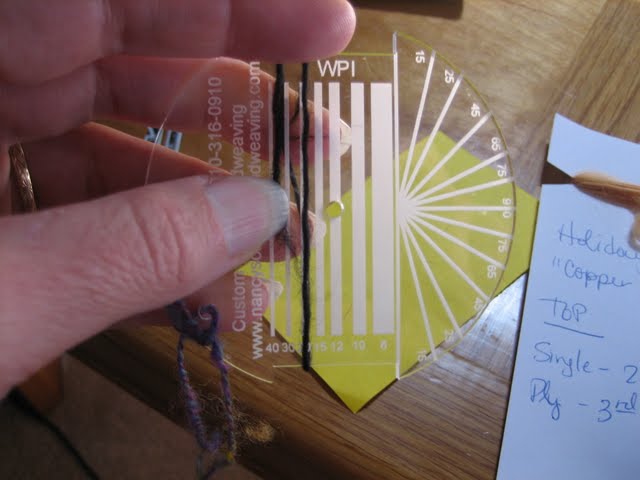
From the picture, you can see that the single is close to 20 WPI. It was a bit of a challenge to get an accurate measurement that wasn't stretching the single, but I decided this was good enough to get a start. Another thing to keep in mind is that the finished yarn will bloom (increase in size) after it's washed and dried. So, I chose 20-25 WPI as a good starting point for my single.
Step 2: Sample singles and ply - first try
Armed with a target WPI for my singles, I sat down at the wheel and started spinning. I knew that the end yarn would be a true three-ply so I made sure to spin that way from the first. I set up my wheel as I normally would, grabbed about an ounce of fiber, split it into three roughly equal parts and had at it.
I kept my control card with me throughout the spinning and used it to ensure that I stayed close to my target. In the end, I kept drifting to a smaller single despite increasing the tension and slowing my treadling - generally between 25 and 30 WPI. I also took a length of the single at the beginning and end of each bobbin and made an "instant yarn" by letting it ply back on itself, again, to see if I was close. While the single was a doubtless a bit thin, the ply experiments looked quite close to the Cascade 220. Therefore, I soldiered on, finished all three singles and then plied. It still looked thin, but I was counting on a good bloom to the yarn when it was done. In the end, I got a lovely yarn that was too thin - on it's way to sport weight rather than DK.

Step 3: Sample singles and ply - second try
Given that I couldn't convince myself that this yarn would be anywhere close to where I wanted to end up, I went ahead and did a second round of sampling. Clearly, I needed to get more fiber into the yarn and just increasing the tension more and slowing my treadling further wasn't going to cut it.
Enter Judith.
I've been lucky enough to take three classes with Judith now and each time only a small portion of her knowledge seems to make it into my brain. This last time we were spinning silk and she often reminded us that each of us has a natural spinning rhythm. That said, we also needed to embrace that rhythm and learn to adjust the wheel so that our natural rhythm would yield the desired yarn. I didn't fully grasp that until this particular moment.
Go down to a lower whorl (equivalent of slower treading) and adjust the take-up to work with that whorl and then see what happens.
Magic. Absolute magic. Those poor whorls sitting on the high end of my Julia - long suffering as I bemoaned my inability to spin fatter gauge yarns. Feh. I eventually popped up two whorls above my default single and suddenly I was spinning a single that was 20 WPI with ease. I felt that I could have gotten to an even fatter single without too much fiddling at that pace. Fantastic! I quickly (and I do mean quickly!) finished spinning up the singles, plied my skein (few beats per length since it needs fewer twists per inch) and sent it off for a bath. What a result.
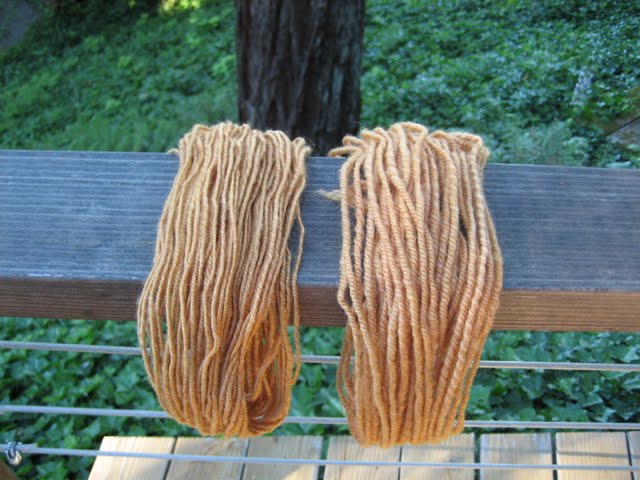


I also learned that my control and consistency improved if I split the roving lengthwise before starting to spin. Again, given that this was no longer strictly top, I wasn't doing myself or the fiber a disservice by manipulating it a bit to make the spinning easier. I'll keep doing this going forward.

Step 4: Swatching for gauge
Now satisfied that I had a yarn that was a good candidate for the cardigan, I grabbed my needles and started swatching. I know that I'm generally a loose knitter and that means I use a smaller needle than most so I grabbed a US4 and cast on for a stockinette swatch. I knitted away for 15 rows and then measured. The swatch was measuring five SPI but the stitches looked a lumpy so, I ripped back, stayed on 4s and knit more tightly. This attempt yielded a honest 5.5 SPI and was happy with the horizontal gauge, but again, the stitches looked lumpy - as if they were too vertically compressed. That led me to rip back again, move up to a US5 needle and end up with this result:

It's perfect. An honest 5.5 stitches per inch and I really like the proportion of the stitches versus rows and even the little bit of twisted cable looks tidy. How much do I love this swatch? This much:

And let's not even get started on the color. It's fabulous. It shines (thank you, BFL!) and it is warm as the last sunny day before winter sets in (thank you, Jennifer!). I want to pet this yarn and this swatch forever. I can't wait to make this cardigan so I can wrap myself in squishy honey. Now it's all about filling the bobbins.
One thing I'm *not* doing as part of this experience is woolen versus worsted spinning. The Blue Faced Leicester roving that I've purchased is a long wool and therefore wants to be spun worsted as much as possible. It started out life as combed top, but the act of dyeing will disorganize the fibers somewhat so it's no longer "top" in the strictest sense. Regardless, I'll be spinning it worsted as long my hands and patience will allow. So, on we go.
Step 1: Determine a target single wraps per inch (WPI)
Sandi is asking us to use a yarn that knits up at 5.5 or 6 stitches per inch (SPI) - that means a DK to light worsted finished yarn. However, since this is a cardigan and I'd like to knit at 5.5 SPI so that it's a bit denser, I pulled out some worsted yarns that have gotten me that gauge in the past. Specifically, I pulled out Cascade 220 - this knits up to 5.5 stitches per inch with a drape that I like.
Next, to get a target WPI for my single, I separated the strand of yarn into its constituent plies. Then, I took one of the singles, along with my control card, and tried to figure out which one was close.
From the picture, you can see that the single is close to 20 WPI. It was a bit of a challenge to get an accurate measurement that wasn't stretching the single, but I decided this was good enough to get a start. Another thing to keep in mind is that the finished yarn will bloom (increase in size) after it's washed and dried. So, I chose 20-25 WPI as a good starting point for my single.
Step 2: Sample singles and ply - first try
Armed with a target WPI for my singles, I sat down at the wheel and started spinning. I knew that the end yarn would be a true three-ply so I made sure to spin that way from the first. I set up my wheel as I normally would, grabbed about an ounce of fiber, split it into three roughly equal parts and had at it.
I kept my control card with me throughout the spinning and used it to ensure that I stayed close to my target. In the end, I kept drifting to a smaller single despite increasing the tension and slowing my treadling - generally between 25 and 30 WPI. I also took a length of the single at the beginning and end of each bobbin and made an "instant yarn" by letting it ply back on itself, again, to see if I was close. While the single was a doubtless a bit thin, the ply experiments looked quite close to the Cascade 220. Therefore, I soldiered on, finished all three singles and then plied. It still looked thin, but I was counting on a good bloom to the yarn when it was done. In the end, I got a lovely yarn that was too thin - on it's way to sport weight rather than DK.
Step 3: Sample singles and ply - second try
Given that I couldn't convince myself that this yarn would be anywhere close to where I wanted to end up, I went ahead and did a second round of sampling. Clearly, I needed to get more fiber into the yarn and just increasing the tension more and slowing my treadling further wasn't going to cut it.
Enter Judith.
I've been lucky enough to take three classes with Judith now and each time only a small portion of her knowledge seems to make it into my brain. This last time we were spinning silk and she often reminded us that each of us has a natural spinning rhythm. That said, we also needed to embrace that rhythm and learn to adjust the wheel so that our natural rhythm would yield the desired yarn. I didn't fully grasp that until this particular moment.
Go down to a lower whorl (equivalent of slower treading) and adjust the take-up to work with that whorl and then see what happens.
Magic. Absolute magic. Those poor whorls sitting on the high end of my Julia - long suffering as I bemoaned my inability to spin fatter gauge yarns. Feh. I eventually popped up two whorls above my default single and suddenly I was spinning a single that was 20 WPI with ease. I felt that I could have gotten to an even fatter single without too much fiddling at that pace. Fantastic! I quickly (and I do mean quickly!) finished spinning up the singles, plied my skein (few beats per length since it needs fewer twists per inch) and sent it off for a bath. What a result.
I also learned that my control and consistency improved if I split the roving lengthwise before starting to spin. Again, given that this was no longer strictly top, I wasn't doing myself or the fiber a disservice by manipulating it a bit to make the spinning easier. I'll keep doing this going forward.
Step 4: Swatching for gauge
Now satisfied that I had a yarn that was a good candidate for the cardigan, I grabbed my needles and started swatching. I know that I'm generally a loose knitter and that means I use a smaller needle than most so I grabbed a US4 and cast on for a stockinette swatch. I knitted away for 15 rows and then measured. The swatch was measuring five SPI but the stitches looked a lumpy so, I ripped back, stayed on 4s and knit more tightly. This attempt yielded a honest 5.5 SPI and was happy with the horizontal gauge, but again, the stitches looked lumpy - as if they were too vertically compressed. That led me to rip back again, move up to a US5 needle and end up with this result:
It's perfect. An honest 5.5 stitches per inch and I really like the proportion of the stitches versus rows and even the little bit of twisted cable looks tidy. How much do I love this swatch? This much:
And let's not even get started on the color. It's fabulous. It shines (thank you, BFL!) and it is warm as the last sunny day before winter sets in (thank you, Jennifer!). I want to pet this yarn and this swatch forever. I can't wait to make this cardigan so I can wrap myself in squishy honey. Now it's all about filling the bobbins.
Being nice
I'm going to take a brief moment to vent.
When it comes to business, I don't subscribe to the "always be nice" idea. Let me say that I do, in general, try to be kind to my colleagues. I try to communicate with them in ways that they will understand (visual vs. aural, go through pleasantries before getting down to the issue at hand; establishing relationships; yadda yadda) and make the experience of working together as easy as possible. However, I also believe that they will meet me halfway.
In the event that this state of detente cannot be reached, business still needs to be conducted. Work still must be done. Problems must be solved, products must be manufactured and money must be made. Colleagues honestly don't have to like each other, but we do need to be consistent and professional in our relationships.
Nothing, but NOTHING torques me harder than failure to follow this thinking. I simply don't understand why one person must succeed on the back of another.
There. Much better.
When it comes to business, I don't subscribe to the "always be nice" idea. Let me say that I do, in general, try to be kind to my colleagues. I try to communicate with them in ways that they will understand (visual vs. aural, go through pleasantries before getting down to the issue at hand; establishing relationships; yadda yadda) and make the experience of working together as easy as possible. However, I also believe that they will meet me halfway.
In the event that this state of detente cannot be reached, business still needs to be conducted. Work still must be done. Problems must be solved, products must be manufactured and money must be made. Colleagues honestly don't have to like each other, but we do need to be consistent and professional in our relationships.
Nothing, but NOTHING torques me harder than failure to follow this thinking. I simply don't understand why one person must succeed on the back of another.
There. Much better.
Spinning with a purpose
Over in Ravelry, a group of us are getting ready to do a KnitALong (KAL) with Sandi Wiseheart. End result of the KAL is a cardigan that's been designed to fit the knitter (or the knitter's intended victim) and also teach us about the designing process along the way. Sandi will be starting the KAL in August because I, hopefully along with a few others, plan to spin yarn specifically for this project.
I've started a thread on Rav for those SpinningALong (SAL) but am going to blog about it as well. That should let me ramble on a bit more and add pictures where it makes sense. Goal of this series of posts is to talk about the process of spinning for a specific project with an eye toward making a yarn that you love and that also works for it’s intended project.
I’m also working with Sandi to write up a swatch that’ll be indicative of the small amount of non-stockinette patterning that is part of her design so that you’ll be able to really get an idea of what the finished product will look like. That swatch will be posted here for all to see/use.
Full disclosure - I’m a very new spinner and I certainly don’t have all the answers! This is more of an opportunity for me to be a bit public about my thought process and hopefully give and get guidance along the way.
Jennifer and Susan will be offering dyed Blue-Faced Leicster roving in both superwash and non-superwash. Please consider purchasing through them to help support the project! Details for purchasing fiber and yarn should be available this coming Thursday, 6/24.
In an earlier post, Sandi pointed us to this Knitting Daily blog entry to help determine how much yarn will be required to knit up her cardigan. To save folks some electrons, here’s the relevant section:
Misses Sizes 32-40 Bust (for a regular, comfortable-ease pullover; add 5% for a cardigan)
* sportweight: 1400-1600 yards (1300-1500 meters)
* worsted weight: 1100-1400 yards (1000-1300 meters)
For a longer, loosely fitting, or oversized misses-sized pullover (add 5% for a cardigan)
* sportweight: 1500-1900 yards (1400-1750 meters)
* worsted weight: 1300-1500 yards (1200-1400 meters)
Since the yarn Sandi calls for is a DK/light-worsted, I’m looking at numbers between sportweight and worsted to estimate my yardage requirements. Using straight-line interpolation, I’m making this estimate:
Standard fit pullover (add 5% for cardigan): 1250 - 1500 yards (1150 - 1400 meters)
Loose-fit pullover (ad 5% for cardigan): 1450 - 1700 yards (1300 - 1575 meters)
The extra 5% nets out to less than 100 yards in all cases.
My bust size is a 34, so I start out at the low end of the yardage scale so I’ll do my estimate for a size 34 and then do some fudging from there. I’m going to shoot for 1300 yards of yarn.
Next step is to work out fiber based on that yardage requirement.
A little surveying of DK weight yarns put me in the neighborhood of 250yds per 4oz. This is a bit over-estimated and also mill-spun. Handspun is often of a lower Yards Per Pound (ypp) than millspun simply because of the way the commercial process handles fiber. Again, since I’ll be reserving for sampling and generally rounding up, I’m not going to get too hung up on this.
Ok, back to calculating.
1300 yards, divided by 250 yards = 5.2
Multiply that by 4oz = 20.8oz
16oz per pound and we get = 1.3 pounds.
Being conservative and ensuring that I have enough to sample, I should be able to get away with 1.5 pounds. But, since I’m really planing to have at it, I’m ordering 1.75 pounds. This will let me relax and make up a decent sized sample skein (maybe two) so that I can ensure I’m doing the Right Thing.
Comments/corrections/readjustments welcome.
I've started a thread on Rav for those SpinningALong (SAL) but am going to blog about it as well. That should let me ramble on a bit more and add pictures where it makes sense. Goal of this series of posts is to talk about the process of spinning for a specific project with an eye toward making a yarn that you love and that also works for it’s intended project.
I’m also working with Sandi to write up a swatch that’ll be indicative of the small amount of non-stockinette patterning that is part of her design so that you’ll be able to really get an idea of what the finished product will look like. That swatch will be posted here for all to see/use.
Full disclosure - I’m a very new spinner and I certainly don’t have all the answers! This is more of an opportunity for me to be a bit public about my thought process and hopefully give and get guidance along the way.
Jennifer and Susan will be offering dyed Blue-Faced Leicster roving in both superwash and non-superwash. Please consider purchasing through them to help support the project! Details for purchasing fiber and yarn should be available this coming Thursday, 6/24.
In an earlier post, Sandi pointed us to this Knitting Daily blog entry to help determine how much yarn will be required to knit up her cardigan. To save folks some electrons, here’s the relevant section:
Misses Sizes 32-40 Bust (for a regular, comfortable-ease pullover; add 5% for a cardigan)
* sportweight: 1400-1600 yards (1300-1500 meters)
* worsted weight: 1100-1400 yards (1000-1300 meters)
For a longer, loosely fitting, or oversized misses-sized pullover (add 5% for a cardigan)
* sportweight: 1500-1900 yards (1400-1750 meters)
* worsted weight: 1300-1500 yards (1200-1400 meters)
Since the yarn Sandi calls for is a DK/light-worsted, I’m looking at numbers between sportweight and worsted to estimate my yardage requirements. Using straight-line interpolation, I’m making this estimate:
Standard fit pullover (add 5% for cardigan): 1250 - 1500 yards (1150 - 1400 meters)
Loose-fit pullover (ad 5% for cardigan): 1450 - 1700 yards (1300 - 1575 meters)
The extra 5% nets out to less than 100 yards in all cases.
My bust size is a 34, so I start out at the low end of the yardage scale so I’ll do my estimate for a size 34 and then do some fudging from there. I’m going to shoot for 1300 yards of yarn.
Next step is to work out fiber based on that yardage requirement.
A little surveying of DK weight yarns put me in the neighborhood of 250yds per 4oz. This is a bit over-estimated and also mill-spun. Handspun is often of a lower Yards Per Pound (ypp) than millspun simply because of the way the commercial process handles fiber. Again, since I’ll be reserving for sampling and generally rounding up, I’m not going to get too hung up on this.
Ok, back to calculating.
1300 yards, divided by 250 yards = 5.2
Multiply that by 4oz = 20.8oz
16oz per pound and we get = 1.3 pounds.
Being conservative and ensuring that I have enough to sample, I should be able to get away with 1.5 pounds. But, since I’m really planing to have at it, I’m ordering 1.75 pounds. This will let me relax and make up a decent sized sample skein (maybe two) so that I can ensure I’m doing the Right Thing.
Comments/corrections/readjustments welcome.
Fiber-y goodness
It's been a while (again) since I've posted anything and I've got some fun stuff to show! I was lucky enough to get to the Monterey Fleece Auction at the Monterey County Fair (they sell tequila *shots* at the fair, how cool is that!??!) two weekends ago and that kicked me in the butt to start dyeing.
I've been wanting to dye my own stuff for quite some time, and the carding fun during the TDF really got me thinking about it. Finally, what pushed me over the edge was the wonderful fleece I bought at the auction. Nine pounds of Coopworth Romney cross, in a lovely gray. Oh, here's what it looks like:

Isn't it gorgeous? The majority went off to Morro Fleece Works for processing, but I stashed about 1# in a ziplock before heading home. This is post washing and pre-dyeing. Since it's gray, I wanted to try and get some blues and purples for scarves. I dyed the locks using acid dyes in the microwave. I don't think I got the water hot enough, but here's the blue pre-carding, and then the two finished batts:


I was quite surprised at how much the colors muted after carding, but the softness of both is just amazing. Have I mentioned how much I love my drum carder? Love. LOVE.
Anyway, I also had two pounds of merino top just lying around waiting for some love, so I decided to do some quick experimenting with kettle dyeing and hot-pouring. I'm much braver now about really heating the water/wool mixture and I just dove in. All the examples below use 4oz. of roving, so I've still got a pound of un-dyed roving leftover. The kettle dyeing was simple - just dump the dye in the bath along with the wool, then heat to set. For the hot pour, I heated the wool and bath *first*, then added the dye.
While I didn't take pictures of the kettle dyeing (too simple, I guess), I did try and document the hot pour. First experiment was with a blue mixture. I used a syringe to squirt the dye on half the roving:

Once that was done, and the dye started to settle, I carefully turned the roving over in the bath to distribute the remaining pigment:

For the green, I first added some water to my dye solution so that it would be less concentrated. Then, I poured more equally across the top of the fiber:

Again, once the dye pushed through and settled, I turned the fiber to better distribute the remaining dyestock

In both cases, I let the fiber cool completely in the dyebath and the dye was fully exhausted. Then, I picked the rovings out of the dyebaths, rinsed under luke-warm tap water, squeezed out as much water as I could, gave it a whiz in a garment bacg ala Alden Amos and then left to dry overnight. Results of the whole shebang look like this:

Again, the blue and green were hot-pour and the orange and yellow were kettle dyed.
All four of them are just *lovely*. The yellow is so wonderfully bright and makes me smile whenever I see it. I'm really in love with the blue - there are these great bits of blue/green in the darker areas and it's all pretty close to what I wanted. I'm going to try one more hot-pour experiment with an intent of getting more colors into the mix. I think I need less water in the bath overall (the wool floated too high) and to not rush the dye getting into the undyed spots. Regardless, I'm definitely on my way!
Oh, and in case you've not figured this out, the next color is in the reds/magentas. That part is missing from my color wheel.
Spinning soon!!! I need a happy, yellow scarf to chase away the winter chill. It is summer in San Francisco, after all.
I've been wanting to dye my own stuff for quite some time, and the carding fun during the TDF really got me thinking about it. Finally, what pushed me over the edge was the wonderful fleece I bought at the auction. Nine pounds of Coopworth Romney cross, in a lovely gray. Oh, here's what it looks like:
Isn't it gorgeous? The majority went off to Morro Fleece Works for processing, but I stashed about 1# in a ziplock before heading home. This is post washing and pre-dyeing. Since it's gray, I wanted to try and get some blues and purples for scarves. I dyed the locks using acid dyes in the microwave. I don't think I got the water hot enough, but here's the blue pre-carding, and then the two finished batts:
I was quite surprised at how much the colors muted after carding, but the softness of both is just amazing. Have I mentioned how much I love my drum carder? Love. LOVE.
Anyway, I also had two pounds of merino top just lying around waiting for some love, so I decided to do some quick experimenting with kettle dyeing and hot-pouring. I'm much braver now about really heating the water/wool mixture and I just dove in. All the examples below use 4oz. of roving, so I've still got a pound of un-dyed roving leftover. The kettle dyeing was simple - just dump the dye in the bath along with the wool, then heat to set. For the hot pour, I heated the wool and bath *first*, then added the dye.
While I didn't take pictures of the kettle dyeing (too simple, I guess), I did try and document the hot pour. First experiment was with a blue mixture. I used a syringe to squirt the dye on half the roving:
Once that was done, and the dye started to settle, I carefully turned the roving over in the bath to distribute the remaining pigment:
For the green, I first added some water to my dye solution so that it would be less concentrated. Then, I poured more equally across the top of the fiber:
Again, once the dye pushed through and settled, I turned the fiber to better distribute the remaining dyestock
In both cases, I let the fiber cool completely in the dyebath and the dye was fully exhausted. Then, I picked the rovings out of the dyebaths, rinsed under luke-warm tap water, squeezed out as much water as I could, gave it a whiz in a garment bacg ala Alden Amos and then left to dry overnight. Results of the whole shebang look like this:
Again, the blue and green were hot-pour and the orange and yellow were kettle dyed.
All four of them are just *lovely*. The yellow is so wonderfully bright and makes me smile whenever I see it. I'm really in love with the blue - there are these great bits of blue/green in the darker areas and it's all pretty close to what I wanted. I'm going to try one more hot-pour experiment with an intent of getting more colors into the mix. I think I need less water in the bath overall (the wool floated too high) and to not rush the dye getting into the undyed spots. Regardless, I'm definitely on my way!
Oh, and in case you've not figured this out, the next color is in the reds/magentas. That part is missing from my color wheel.
Spinning soon!!! I need a happy, yellow scarf to chase away the winter chill. It is summer in San Francisco, after all.
And in other news ...
I've got a quick FO sighting for y'all.

This is a Beech Wood Cowl done in bamboo/merino handspun. Colorway is Sangria by Spunky Eclectic. I got the fiber from a fellow Raveler as part of a "bag of crap" fiber swap. I was shooting for something heavier weight than the light fingering I usually end up with. This is about 10wpi, chain-plied. BTW, I'm falling in LOVE with chain-plying. Now that I'm confident in the process, it makes yarn happen almost instantaneously.
Yardage: ~170
WPI: ~11
Fiber: 80/20 merino/bamboo

I'm wearing it 'round the office today 'cause I lurves it.
Off to the mountains tonight for the long weekend and the start of the TDF. I'll post the "stash target" when I get back next week.

This is a Beech Wood Cowl done in bamboo/merino handspun. Colorway is Sangria by Spunky Eclectic. I got the fiber from a fellow Raveler as part of a "bag of crap" fiber swap. I was shooting for something heavier weight than the light fingering I usually end up with. This is about 10wpi, chain-plied. BTW, I'm falling in LOVE with chain-plying. Now that I'm confident in the process, it makes yarn happen almost instantaneously.
Yardage: ~170
WPI: ~11
Fiber: 80/20 merino/bamboo

I'm wearing it 'round the office today 'cause I lurves it.
Off to the mountains tonight for the long weekend and the start of the TDF. I'll post the "stash target" when I get back next week.
Three Bags Full
Today I started pulling out the fiber for the Tour.
I've joined a couple of teams: Team Monkey Farts, sponsored by Spunky Eclectic, Team Suck Less, sponsored by Abby Franquemont and Team Snobby Spinners. For the last one, it's all about spinning "luxury" fibers. Links go to the groups in Ravelry.
Monkey Farts is my cheerleading team. There's no Spunky fiber targeted specifically for the Tour, but I wouldn't be surprised if one of the club fibers finds it way onto a spindle this month.
Team Suck Less is all about spinning a MILE of fiber in one day. A mile is 1760 yards, and if you 3-ply that, it works out to 580-ish yards. That's more than a pair of sock's wort (usually ~400 yards) and would work out to be around 5-6 oz of fiber. That's alot. That's about 10h *straight* of spinning. I'll be doing this on a Saturday.
Finally, for Team Snobby Spinners, I've got a choice of some lovely polwarth/silk blend that spins up frog-hair fine for lace or 4oz of some really nice bamboo/merino blend. I think that's the one for me.
The overall fiber count for the Tour looks like this:
1.5# of Merino for a sweater. Comes from The Sheep Shed and Carolina Homespun. The two sets of fiber are close cousins and are broken into three sets of 1/2 a pound, each. Makes it easy for the 3-ply I'm planning. This is targeted for the Wisteria Sweater from Twist Collective.
4oz of Bamboo/Merino blend. These'll be for socks. May use the SpinOff article from last year to split and ply the fiber. Otherwise, I'll be waffling between chain and true 3-ply. That's for later in the month.
~2# of Shetland fleece. My first one. I'd had some thought of dying this before I spin it, but I've both run out of time and am no longer sure that's what I want to do. If I save this for last, I can still "plot" a bit.
Anyway, I'm looking forward to this - quite a bit, actually. It's gonna be great to reconnect with my wheel, play around with my carder and generally spin until I just don't want to anymore.
It's training for SOAR in October, right?
I've joined a couple of teams: Team Monkey Farts, sponsored by Spunky Eclectic, Team Suck Less, sponsored by Abby Franquemont and Team Snobby Spinners. For the last one, it's all about spinning "luxury" fibers. Links go to the groups in Ravelry.
Monkey Farts is my cheerleading team. There's no Spunky fiber targeted specifically for the Tour, but I wouldn't be surprised if one of the club fibers finds it way onto a spindle this month.
Team Suck Less is all about spinning a MILE of fiber in one day. A mile is 1760 yards, and if you 3-ply that, it works out to 580-ish yards. That's more than a pair of sock's wort (usually ~400 yards) and would work out to be around 5-6 oz of fiber. That's alot. That's about 10h *straight* of spinning. I'll be doing this on a Saturday.
Finally, for Team Snobby Spinners, I've got a choice of some lovely polwarth/silk blend that spins up frog-hair fine for lace or 4oz of some really nice bamboo/merino blend. I think that's the one for me.
The overall fiber count for the Tour looks like this:
1.5# of Merino for a sweater. Comes from The Sheep Shed and Carolina Homespun. The two sets of fiber are close cousins and are broken into three sets of 1/2 a pound, each. Makes it easy for the 3-ply I'm planning. This is targeted for the Wisteria Sweater from Twist Collective.
4oz of Bamboo/Merino blend. These'll be for socks. May use the SpinOff article from last year to split and ply the fiber. Otherwise, I'll be waffling between chain and true 3-ply. That's for later in the month.
~2# of Shetland fleece. My first one. I'd had some thought of dying this before I spin it, but I've both run out of time and am no longer sure that's what I want to do. If I save this for last, I can still "plot" a bit.
Anyway, I'm looking forward to this - quite a bit, actually. It's gonna be great to reconnect with my wheel, play around with my carder and generally spin until I just don't want to anymore.
It's training for SOAR in October, right?
Beer-thirty
This weekend, we hauled the brewing equipment out and made beer.
Before moving to California, brewing was a monthly (minimum) exercise with a very dear friend. I have wonderful memories of sitting on the porch, in all weather (even in the snow), with our cauldron of malty goodness bubbling away while talking about, well, everything. I've not found a new brew-buddy out here; and Chris and I brew together (he's good for the heavy lifting), but I still miss Andy on brew day.
Anyway, yesterday's beer was dead simple.
Grain Bill:
7# 2-row klages malt
1# malted wheat
1# Vienna malt
Strike with ~13qts of water at 165F, aiming for a mash temperature of 150F. We used about 12 quarts and hit 152F. Perfect. Skipped the protein rest 'cause it was all in the Gott cooler and I just couldn't be bothered.
Let rest until conversion is complete. We went hiking for an hour. :-)
Add about 3gal of sparge water at 180F to get the mash up to 170F. Sparge until liquor is at 1.008. We netted out about 6.5 gallons.
Add 1 oz Hallertau (~4.8AAU) at 0 mins, 1/2 oz Saaz and 1/4 oz Fuggles at 30 mins, another 1/4 oz Fuggles at 40 mins, another 1/4 oz Saaz plus 2T rehydrated Irish Moss at 55 mins.
After 60 mins, chill to ~80F and siphon into a 7g carboy. Add White Labs Kolsch yeast, slap on the air lock and Bob's yer Uncle.
Original Gravity: 1.050
Original Volume: ~6gal
Not bad at all. BTW, it's already delicious.
Before moving to California, brewing was a monthly (minimum) exercise with a very dear friend. I have wonderful memories of sitting on the porch, in all weather (even in the snow), with our cauldron of malty goodness bubbling away while talking about, well, everything. I've not found a new brew-buddy out here; and Chris and I brew together (he's good for the heavy lifting), but I still miss Andy on brew day.
Anyway, yesterday's beer was dead simple.
Grain Bill:
7# 2-row klages malt
1# malted wheat
1# Vienna malt
Strike with ~13qts of water at 165F, aiming for a mash temperature of 150F. We used about 12 quarts and hit 152F. Perfect. Skipped the protein rest 'cause it was all in the Gott cooler and I just couldn't be bothered.
Let rest until conversion is complete. We went hiking for an hour. :-)
Add about 3gal of sparge water at 180F to get the mash up to 170F. Sparge until liquor is at 1.008. We netted out about 6.5 gallons.
Add 1 oz Hallertau (~4.8AAU) at 0 mins, 1/2 oz Saaz and 1/4 oz Fuggles at 30 mins, another 1/4 oz Fuggles at 40 mins, another 1/4 oz Saaz plus 2T rehydrated Irish Moss at 55 mins.
After 60 mins, chill to ~80F and siphon into a 7g carboy. Add White Labs Kolsch yeast, slap on the air lock and Bob's yer Uncle.
Original Gravity: 1.050
Original Volume: ~6gal
Not bad at all. BTW, it's already delicious.
I'll take two.
Must. Make. This.
I'm going to go sit in the corner and be very, very good. Hopefully this will show up.
I'm going to go sit in the corner and be very, very good. Hopefully this will show up.
Little things
For me, the little things in life are important. I tend to get so busy that I don't always do the "normal stuff" like cleaning, vacuuming or folding the laundry. And, in life's silly ways, neglecting the "normal stuff" can lead to neglecting the big stuff.
Suffice to say that last year was not my finest. I'd say it was a continuation of quite a few years of not paying enough attention to the world around me and really losing track of what was important. I came within an inch of being single again - after nearly 20 years together - and boy was that horrible.
Where am I going with this? Well, in "happier days", Chris was pretty good at letting me know he was thinking about me by sending me flowers. It didn't happen regularly - but he always managed to figure out when I was feeling sad, or missing him, or just totally overwhelmed by life. A lovely bouquet would show up at work, on the table at home - and even once in China! There is nothing, absolutely nothing, that touches me so.
Anyway, when we were having "trouble", I actually noticed that the flowers didn't happen anymore. We'd argue. We'd pick on each other. I'd cry. While I didn't "expect" them per se, I did notice that he didn't seem to think about it anymore.
Fast forward to today. I was away again last week and came home on Saturday morning. He's been working his tail off to get the race car up and running again for a track day tomorrow and he and his partner ran into all sorts of problems. Knowing I'd be all foggy and tired, I sent him off to work on the car. Turned out that they had more problems and "one day" became "all weekend". Plus, tonight he's off to head up to the race track. Yeah, I was a little sad about it but I didn't want to prevent him from getting his stuff done. It's not every weekend, he really loves doing it, and it needs to happen.
He noticed.

I really do love that man.
Suffice to say that last year was not my finest. I'd say it was a continuation of quite a few years of not paying enough attention to the world around me and really losing track of what was important. I came within an inch of being single again - after nearly 20 years together - and boy was that horrible.
Where am I going with this? Well, in "happier days", Chris was pretty good at letting me know he was thinking about me by sending me flowers. It didn't happen regularly - but he always managed to figure out when I was feeling sad, or missing him, or just totally overwhelmed by life. A lovely bouquet would show up at work, on the table at home - and even once in China! There is nothing, absolutely nothing, that touches me so.
Anyway, when we were having "trouble", I actually noticed that the flowers didn't happen anymore. We'd argue. We'd pick on each other. I'd cry. While I didn't "expect" them per se, I did notice that he didn't seem to think about it anymore.
Fast forward to today. I was away again last week and came home on Saturday morning. He's been working his tail off to get the race car up and running again for a track day tomorrow and he and his partner ran into all sorts of problems. Knowing I'd be all foggy and tired, I sent him off to work on the car. Turned out that they had more problems and "one day" became "all weekend". Plus, tonight he's off to head up to the race track. Yeah, I was a little sad about it but I didn't want to prevent him from getting his stuff done. It's not every weekend, he really loves doing it, and it needs to happen.
He noticed.

I really do love that man.
Bathtub Rings
In yesterday's post, I threatened to wash a fleece. Now, I should admit that I'm one of those people that likes (needs) procrastination. I like to hem, haw, deliberate, do thought experiments and generally delay actually *doing* something until I feel like I can be successful. It's definitely overkill in terms of angst and nervousness, but the net result is that I do eventually conquer my fears and just "try".
After putting up that post yesterday, I was absolutely GRIPPED by the idea of washing the fleece. I thought about it ALL DAY. Finally, after I'd finished up my work for the day, I picked up a few necessities at the store (drying rack, laundry bags) and just, well, tucked in.
I turned up the water heater (involved disassembling the darned thing), shook/picked over the fleece and just, well, washed it. Two soapy dunks, two rinsy dunks, some dangerous whirling of the bagged fleece in the driveway and it was over. Pretty anti-climactic, actually.
As of last night, it was taking up all three tiers of the drying rack in the living room. It's not felted. It's pretty clean (compared to the state it was in yesterday). I think I'll do this again.
(will add pix when I get them off the camera)
Tomorrow is Spinners' Day at the Farm up in the North Bay. Looking forward to sun, wool and pot-luck!
After putting up that post yesterday, I was absolutely GRIPPED by the idea of washing the fleece. I thought about it ALL DAY. Finally, after I'd finished up my work for the day, I picked up a few necessities at the store (drying rack, laundry bags) and just, well, tucked in.
I turned up the water heater (involved disassembling the darned thing), shook/picked over the fleece and just, well, washed it. Two soapy dunks, two rinsy dunks, some dangerous whirling of the bagged fleece in the driveway and it was over. Pretty anti-climactic, actually.
As of last night, it was taking up all three tiers of the drying rack in the living room. It's not felted. It's pretty clean (compared to the state it was in yesterday). I think I'll do this again.
(will add pix when I get them off the camera)
Tomorrow is Spinners' Day at the Farm up in the North Bay. Looking forward to sun, wool and pot-luck!
Tour de Fleece - Part Deux!
Last year I wasn't a spinner. Feels pretty wierd to say that given how much I've taken to this fabulous craft. I've always loved fiber and needle arts but spinning has unlocked a whole new measure of creativity. All that being said, I have a special place in my heart for this event 'cause it's what forced me to get off my butt and start spinning.
I won't bore you with the details, but suffice to say that I signed up for SOAR without knowing a thing about spinning. Once signed up, I bought a wheel and then got outed by the Harlot (scroll down to the 05-July post) when I committed to making a skein of yarn during the tour. Just one skein. The rest is history.
Anyway, I'm committed to participating in the Tour de Fleece again this year and this past week has been all about setting my goal(s). My fiber stash is starting to get a little silly and that means I need to get spinning so that I can buy more (natch). Plus, with the addition of my new and loverly loom (LOOOOOM!), I've got new and amazing ways to burn through all the lovely yarn I'll be making.
So, I'm currently thinking about a few things:
1. Spindle spin just a little bit, every work day, over lunch. I'm not a "confident" spindler and that's just lack of practice. I've got time at lunch to do this, so I'm gonna. If I'm in a meeting, the spindle goes to. Phoey.
2. Spin for a sweater. I've got plenty of fiber to make an absolutely lovely version of Wisteria and it'll also be a challenge to spin something larger than sport weight. I can do this - I just KNOW it.
3. Spin a fleece. I've got two - one from a friend down the road (can't believe it's been a year) and one lovely one from Windswept Farms in Michigan. They're both small, but it would also allow me to finally get over my fear of doing this. It's *gotta* be ok for me to wash some wool, darn it!
So, I'm mostly set, I think. It's all doable in the grand scheme of things, provided I do some planning. It's off to China again next week, so I'll have some time to plot/scheme on what gets done and when - and I can try washing the fleece when I get back.
Oh, and I've also got this idea about dying up some roving and spinning that, but maybe that's for next year.
Thoughts? Anyone? Is this thing on?
I won't bore you with the details, but suffice to say that I signed up for SOAR without knowing a thing about spinning. Once signed up, I bought a wheel and then got outed by the Harlot (scroll down to the 05-July post) when I committed to making a skein of yarn during the tour. Just one skein. The rest is history.
Anyway, I'm committed to participating in the Tour de Fleece again this year and this past week has been all about setting my goal(s). My fiber stash is starting to get a little silly and that means I need to get spinning so that I can buy more (natch). Plus, with the addition of my new and loverly loom (LOOOOOM!), I've got new and amazing ways to burn through all the lovely yarn I'll be making.
So, I'm currently thinking about a few things:
1. Spindle spin just a little bit, every work day, over lunch. I'm not a "confident" spindler and that's just lack of practice. I've got time at lunch to do this, so I'm gonna. If I'm in a meeting, the spindle goes to. Phoey.
2. Spin for a sweater. I've got plenty of fiber to make an absolutely lovely version of Wisteria and it'll also be a challenge to spin something larger than sport weight. I can do this - I just KNOW it.
3. Spin a fleece. I've got two - one from a friend down the road (can't believe it's been a year) and one lovely one from Windswept Farms in Michigan. They're both small, but it would also allow me to finally get over my fear of doing this. It's *gotta* be ok for me to wash some wool, darn it!
So, I'm mostly set, I think. It's all doable in the grand scheme of things, provided I do some planning. It's off to China again next week, so I'll have some time to plot/scheme on what gets done and when - and I can try washing the fleece when I get back.
Oh, and I've also got this idea about dying up some roving and spinning that, but maybe that's for next year.
Thoughts? Anyone? Is this thing on?
LOOOOOOOMMMM!
Hooray!
After a week's worth of waiting (I can't believe how spoiled I've been by USPS!) my wonderful new loom finally arrived. It actually showed up this past Friday, but I didn't do a thing with it until Sunday. First, I needed to finish up spinning last month's Spunky Club fiber and then we had a small task to accomplish at a semi-local winery.
So, Sunday morning finally came along and I just had to dive in and get started. I followed the excellent advice of my Spunky and Weaver friends on Ravelry and used Tofutsies as the warp (96", 10epi, 11" on the loom) with the intent of using it as the weft as well. Nice, balanced weave - that's the ticket.
I started warping at around 10a on Sunday. By the time I had to leave for Book Club at 3p, this is the result:

Amazing, isn't it? Like LIGHTNING this stuff is. I kept going and going on Sunday night, then again yesterday. I ran out of the Tofutsies about 2/3 of the way through but I couldn't bear cutting it off and wasting all that weft. So, I dug into my old crochet cotton stash and found a nice ball of ecru cotton. I grabbed that, along with my pickup stick and kept going. And going. And GOING! Then, around 9p last night, I finished. Gave it a quick soak and popped it in the dryer (!!!!!) with the rest of the laundry. A quick press and tying up the ends and voila:

Can you believe it? Isn't it FABULOUS! Wow. WOW. WOW!! I'm totally in love. The cotton is an excellent foil for the Tofutsies and the more-open weave gives it a somewhat similar drape. It softened up so wonderfully in the wash that it's like silk against my skin. Oh, here are a few more:


So there you go. The loom's folded up and stowed under the couch (Chris appreciates this added bonus) but it's likely coming out again tonight. I have this idea for another scarf, but this time I'll be doing some color changes in the weft ... assuming I can figure that out.
Yep, I'm hooked. Absolutely. LOOOOOOOOMMMMMM!
(oh, and who else is up for the Tour de Fleece?)
After a week's worth of waiting (I can't believe how spoiled I've been by USPS!) my wonderful new loom finally arrived. It actually showed up this past Friday, but I didn't do a thing with it until Sunday. First, I needed to finish up spinning last month's Spunky Club fiber and then we had a small task to accomplish at a semi-local winery.
So, Sunday morning finally came along and I just had to dive in and get started. I followed the excellent advice of my Spunky and Weaver friends on Ravelry and used Tofutsies as the warp (96", 10epi, 11" on the loom) with the intent of using it as the weft as well. Nice, balanced weave - that's the ticket.
I started warping at around 10a on Sunday. By the time I had to leave for Book Club at 3p, this is the result:

Amazing, isn't it? Like LIGHTNING this stuff is. I kept going and going on Sunday night, then again yesterday. I ran out of the Tofutsies about 2/3 of the way through but I couldn't bear cutting it off and wasting all that weft. So, I dug into my old crochet cotton stash and found a nice ball of ecru cotton. I grabbed that, along with my pickup stick and kept going. And going. And GOING! Then, around 9p last night, I finished. Gave it a quick soak and popped it in the dryer (!!!!!) with the rest of the laundry. A quick press and tying up the ends and voila:

Can you believe it? Isn't it FABULOUS! Wow. WOW. WOW!! I'm totally in love. The cotton is an excellent foil for the Tofutsies and the more-open weave gives it a somewhat similar drape. It softened up so wonderfully in the wash that it's like silk against my skin. Oh, here are a few more:


So there you go. The loom's folded up and stowed under the couch (Chris appreciates this added bonus) but it's likely coming out again tonight. I have this idea for another scarf, but this time I'll be doing some color changes in the weft ... assuming I can figure that out.
Yep, I'm hooked. Absolutely. LOOOOOOOOMMMMMM!
(oh, and who else is up for the Tour de Fleece?)
What a weekend!
So I mentioned on Friday that my hubby, along with the menfolk from two other friends who are also turning 40 this year, were taking the three of us out for a glorious celebratory weekend. Well, they didn't disappoint. The weather was ideal and we had a great time. Can't you tell?

No photos of the dinner to share (yet). The six of us were all dolled up and enjoyed a nearly four-hour marathon of amazing food and remarkable wine before staggering back to the hotel. I can't even begin to describe what a magical experience it was to eat at the French Laundry. Not every dish was perfect, but the combination of the food, the wine, the presentation and the first class service were more than enough to exceed my expectations. Suffice it to say, if ever given the opportunity, go. Don't walk, run.
Anyway - I'm a very lucky girl. Happy Sunday, folks.

No photos of the dinner to share (yet). The six of us were all dolled up and enjoyed a nearly four-hour marathon of amazing food and remarkable wine before staggering back to the hotel. I can't even begin to describe what a magical experience it was to eat at the French Laundry. Not every dish was perfect, but the combination of the food, the wine, the presentation and the first class service were more than enough to exceed my expectations. Suffice it to say, if ever given the opportunity, go. Don't walk, run.
Anyway - I'm a very lucky girl. Happy Sunday, folks.
More greens - and an exciting weekend
Last week was our first week of fresh veggies from my CSA. Given that we didn't get the box until Friday, not everything was perfect, but I was still enamored with the contents. This week was no exception. We got:
Rainbow Chard
Lettuce Mix
Loose Spinach
French Breakfast Radishes
Green Garlic
Spring Red Onions
Fresh Strawberries
This may, perhaps, sound like less than last week's contents, but that's not necessarily bad. My last salad was eaten the day of arrival for the other box! Anyway, I've not made as much of a dent in this box so far, mainly because I'm still buried under the box of cherries from the orchard, but I'm sure I'll manage to eat all of it.
All that waits until Sunday because we're going away (yet again) for a weekend with friends. My cohorts in crime, Amy and Beth, and I are all turning 40 this year. Our menfolk took it upon themselves to "do something about it" and this weekend is the big deal. The boys did a superb job of keeping things secret, and even managed to ensure that none of us planned anything on our calendars, and they finally started spilling the beans a few weeks ago. Suffice to say, they've done a fabulous job. We're having a weekend of wine tasting, cycling, general mayhem and the crowning achievement is dinner a The French Laundry. I really don't know how wonderful it will be. It's been getting mixed reviews from customers over the past few years (service declining, less variety of menu, prices skyrocketing) but it's still one of those "lifetime" things.
My plan? Close my mental checkbook, open my mouth and enjoy. See you all Monday.
Rainbow Chard
Lettuce Mix
Loose Spinach
French Breakfast Radishes
Green Garlic
Spring Red Onions
Fresh Strawberries
This may, perhaps, sound like less than last week's contents, but that's not necessarily bad. My last salad was eaten the day of arrival for the other box! Anyway, I've not made as much of a dent in this box so far, mainly because I'm still buried under the box of cherries from the orchard, but I'm sure I'll manage to eat all of it.
All that waits until Sunday because we're going away (yet again) for a weekend with friends. My cohorts in crime, Amy and Beth, and I are all turning 40 this year. Our menfolk took it upon themselves to "do something about it" and this weekend is the big deal. The boys did a superb job of keeping things secret, and even managed to ensure that none of us planned anything on our calendars, and they finally started spilling the beans a few weeks ago. Suffice to say, they've done a fabulous job. We're having a weekend of wine tasting, cycling, general mayhem and the crowning achievement is dinner a The French Laundry. I really don't know how wonderful it will be. It's been getting mixed reviews from customers over the past few years (service declining, less variety of menu, prices skyrocketing) but it's still one of those "lifetime" things.
My plan? Close my mental checkbook, open my mouth and enjoy. See you all Monday.
Subscribe to:
Posts (Atom)